"The goal of effective spelling instruction is to create fluent writers, not perfect scores on the spelling test." (Rosencrans, 1997).
According to Michelle Newlands, when children do not know how to spell a word, they tend not to use it in their writing. This limits children's vocabulary and word knowledge. (Newlands, 2011).
When we teach vocabulary, we teach the syntax, the semantics, the orthography, and the symbolic representation of the word.
^ Spelling instruction in turn correlates with word knowledge.
If we can teach children spelling patterns, we can connect them to new words, which in turn can help them feel confident when they incorporate these new words into their writing.
I have come across some activities that can help children practice the spelling of words.

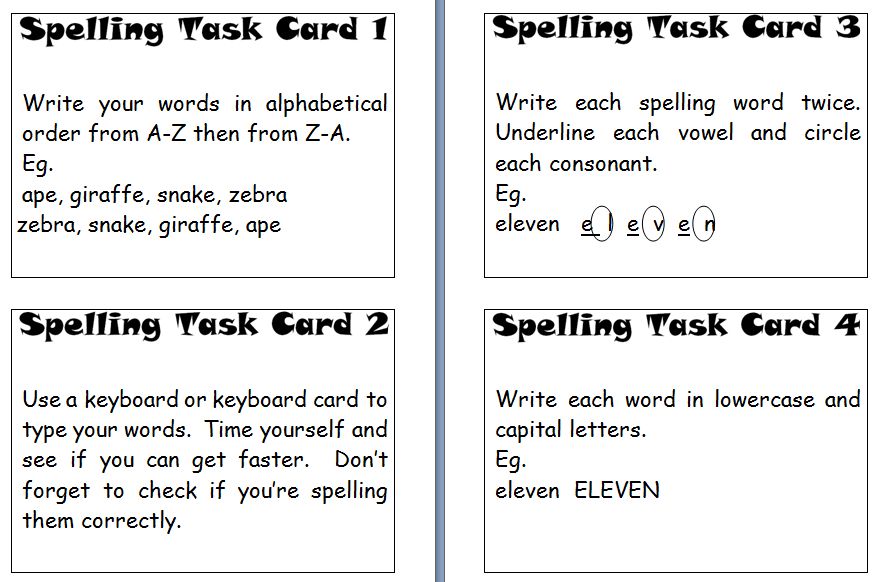
- I visualize these cards being used in centers. These cards are beneficial for students because students can write and view their words in multiple different forms. This practices rehearsal, which we know is best practice for teaching spelling. J. Richard Gentry supports this theory while also using spelling games to help enhance students' learning of how to spell their words (Gentry, 2004).
“Spelling games such as hangman, Scrabble, and spelling tic-tac-toe are popular with children and teachers and, in my view, should play a role in the elementary spelling program.” (Gentry, 2004).
- The Add-A-Word program
This is a strategy where students are given their own spelling lists. The students study these words fully and using many different approaches (like we see in the center cards above). When the student has spelled a word correctly three days in a row, it is dropped from his/her list and a new word is added (Simonsen and Gunter, 2001).
- Word Sorting
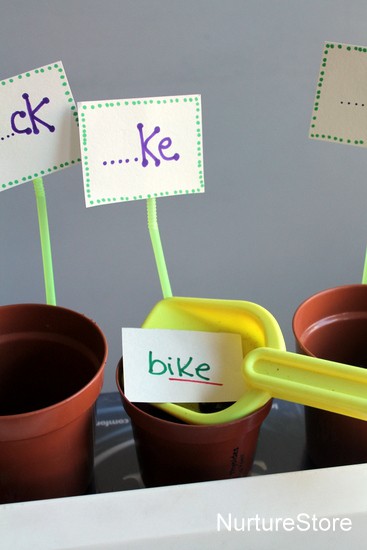
J. Richard Gentry also says that word sorting is a way of practicing words and word patterns so that they may be easily retrieved from memory. Here are some examples of hands-on, word sorting games that students can play.


Now, I ask you, how do you visualize spelling instruction in your classroom?
Resources:
Gentry, J. (2004). The Science of Spelling. Retrieved July 2, 2015, from https://www.heinemann.com/shared/onlineresources/E00717/discovery5.pdf
Newlands, M. (2011). Intentional Spelling: Seven Steps to Eliminate Guessing. The Reading Teacher, 531-534.
Reed, D. (2012). Why Teach Spelling? Retrieved July 2, 2015, from http://www.readingrockets.org/sites/default/files/Why Teach Spelling.pdf
Rosencrans, G. (1997, December 1). The Spelling Book: Teaching Children How To Spell, Not What To Spell. Retrieved July 2, 2015, from http://www.researchgate.net/publication/234566845_The_Spelling_Book_Teaching_Children_How_To_Spell_Not_What_To_Spell
Simonsen, F., & Gunter, L. (2001). Best Practices in Spelling Instruction: A Research Summary. Retrieved July 2, 2015.
Picture Resources:
https://s-media-cache-ak0.pinimg.com/736x/b7/48/f0/b748f062a3dceb773f72858d4b1880ac.jpg


Lindsay, I like you mentioned it is important to teach and show students multiple aspects of words such as vocabulary, syntax, semantics, symbols, etc. This is a great idea to allow students multiple interactions when working with words. I also agree that teaching spelling patterns is an integral aspect when teaching students words because it can allow them to use it multiple times. Lastly, I enjoyed the different classroom applications you mentioned because they can easily be done in a center. I personally would like to use these types of activities in my classroom as well as teaching students multiple aspects of words and spelling patterns.
ReplyDelete