Wednesday, July 1, 2015

How is systematic spelling instruction structured to correlate with word knowledge?

"The goal of effective spelling instruction is to create fluent writers, not perfect scores on the spelling test." (Rosencrans, 1997).


According to Michelle Newlands, when children do not know how to spell a word, they tend not to use it in their writing. This limits children's vocabulary and word knowledge. (Newlands, 2011).


When we teach vocabulary, we teach the syntax, the semantics, the orthography, and the symbolic representation of the word.


^ Spelling instruction in turn correlates with word knowledge.


If we can teach children spelling patterns, we can connect them to new words, which in turn can help them feel confident when they incorporate these new words into their writing.


I have come across some activities that can help children practice the spelling of words.
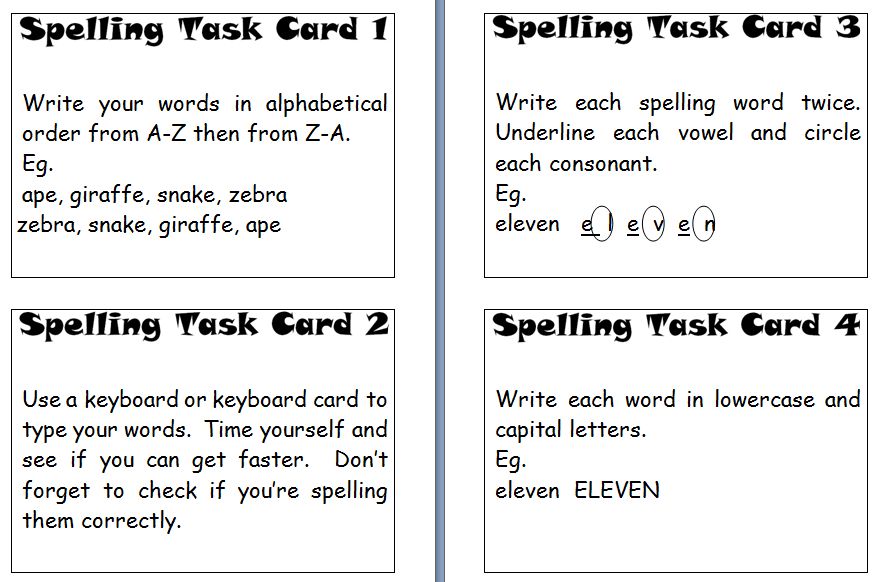
- I visualize these cards being used in centers. These cards are beneficial for students because students can write and view their words in multiple different forms. This practices rehearsal, which we know is best practice for teaching spelling. J. Richard Gentry supports this theory while also using spelling games to help enhance students' learning of how to spell their words (Gentry, 2004).


“Spelling games such as hangman, Scrabble, and spelling tic-tac-toe are popular with children and teachers and, in my view, should play a role in the elementary spelling program.” (Gentry, 2004).


  • The Add-A-Word program
This is a strategy where students are given their own spelling lists. The students study these words fully and using many different approaches (like we see in the center cards above). When the student has spelled a word correctly three days in a row, it is dropped from his/her list and a new word is added (Simonsen and Gunter, 2001).


  • Word Sorting
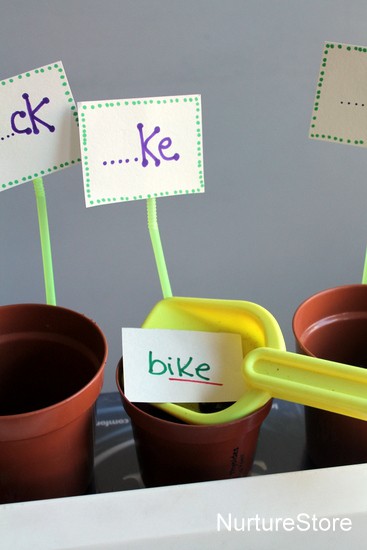
J. Richard Gentry also says that word sorting is a way of practicing words and word patterns so that they may be easily retrieved from memory. Here are some examples of hands-on, word sorting games that students can play.

Now, I ask you, how do you visualize spelling instruction in your classroom? 


Resources:
 Gentry, J. (2004). The Science of Spelling. Retrieved July 2, 2015, from https://www.heinemann.com/shared/onlineresources/E00717/discovery5.pdf 
 Newlands, M. (2011). Intentional Spelling: Seven Steps to Eliminate Guessing. The Reading Teacher, 531-534.
 Reed, D. (2012). Why Teach Spelling? Retrieved July 2, 2015, from http://www.readingrockets.org/sites/default/files/Why Teach Spelling.pdf
 Rosencrans, G. (1997, December 1). The Spelling Book: Teaching Children How To Spell, Not What To Spell. Retrieved July 2, 2015, from http://www.researchgate.net/publication/234566845_The_Spelling_Book_Teaching_Children_How_To_Spell_Not_What_To_Spell
 Simonsen, F., & Gunter, L. (2001). Best Practices in Spelling Instruction: A Research Summary. Retrieved July 2, 2015.

Picture Resources:
https://s-media-cache-ak0.pinimg.com/736x/b7/48/f0/b748f062a3dceb773f72858d4b1880ac.jpg

Wednesday, June 24, 2015

Writing Conferences

According to the Kentucky Department of Education, effective writing conferences happen early and often in the writing process, beginning in the prewriting stage. 

Writing conferences should zero in on one or two areas of need rather than the whole writing piece. 

These conferences can be, but do not have to be one-on-one, they can also occur in a small group.

"Writing conferences do not have to be time-consuming, planned events that occur only after a student has written a draft. Conferences that directly improve writing often occur spontaneously and last less than one minute." (Kentucky Educational Television, 2000). 

Peer conferences are ways for students to learn off of each other, while praising each other at the same time. 
Neon-Revision

  • While viewing the We are Teachers blog, I discovered neon revision. Neon revision is just what you see in this picture. The teacher gives students 3 highlighters and encourages them to look at the sentence starters (looking for differentiation), use of adjectives, and use of verbs. This could also be used to check for alliteration, use of expression, etc. 
Proofreading-Spectacles
  • Proofreading spectacles make peer editing engaging for students. I found this while looking at the We are Teachers blog. This helps students feel motivated to work with their peers in editing and revising their writing. 


"Teaching writing must become more like coaching a sport and less like presenting information. You have to do more than call out the errors."
                                             ~Lucy Calkins (Klein, 2011)
Resources:
Blog - WeAreTeachers. (2015). Retrieved June 24, 2015, from http://www.weareteachers.com/blogs/post/2014/10/07/5-peer-conferencing-strategies-that-actually-work 
How to Improve the Quality of Writing Conferences. (n.d.). Retrieved June 24, 2015, from http://www.ket.org/education/guides/pd/writingconferences.pdf
Klein, S. (n.d.). The Inspired Writer blog. Writing, learning, and living with the Common Core Standards. Retrieved June 24, 2015, from http://writestepswriting.com/Blog/tabid/241/EntryId/6/3-Secrets-to-Great-Conferences-with-Young-Writers.aspx

Tuesday, June 23, 2015

How do students and teachers use digital tools in literacy instruction in K-4 classrooms?


Teachers and students extend traditional literacy experiences with comprehension of information on the internet; effective use of search engines to locate information; evaluation of internet sources; communication using e-mail, texts, and chats; and the use of word processing programs (International Society for Technology in Education, 2007).

Digitally literate people are those who “can use technology strategically to find and evaluate information, connect and collaborate with others, produce and share original content, and use the internet and technology tools to achieve many academic, professional, and personal goals.” (Crowley, 2014).


-- One of my favorite ways to integrate digital literacy in the classroom is through digital texts.


  • Actively Learn is a great website where teachers can upload or choose texts to use with their students. Teachers can create text boxes, include media, embed side notes and visuals, define unknown vocabulary, and ask comprehension questions throughout the text. 
- Here is a video that talks about how Actively Learn works; showing all of its helpful components. 
https://www.youtube.com/watch?v=mZ84_WM4jT8

- Here is an example of a text that I have recreated on Actively Learn. The Three Little Pigs
  • It is also possible to write or rewrite a digital text using Microsoft PowerPoint or Microsoft Word. The same things can be embedded such as text boxes, visuals, questions, definitions, etc.

The use of digital text introduces a host of possibilities for strengthening literacy instruction and supporting struggling readers in the challenging task of reading for understanding in multiple genres, and for diverse purposes (Strangman & Dalton, 2005). 

Now, I ask you, in what ways can you see yourself using digital texts in your classroom?

Resources:
Barone, D., & Wright, T. (n.d.). Literacy Instruction with Digital and Media Technologies. Retrieved June 23, 2015, from http://www.readingrockets.org/article/literacy-instruction-digital-and-media-technologies
Crowley, B. (2015). What Digital Literacy Looks Like in a Classroom. Retrieved June 23, 2015, from http://www.edweek.org/tm/articles/2014/10/29/ctq_crowley_digitalliteracy.html
Stachowiak, J., & Hollingworth, L. (2013). Technology Toolbox for the K-12 Literacy Teacher. Retrieved June 23, 2015, from http://myweb.uiowa.edu/hollingw/index_files/viewcomplimentarytitle.pdf


Thursday, June 18, 2015

Guided Reading

Guided reading is small group, teacher led instruction. According to Pat Cunningham, Cheryl Sigmon, and Dottie Hall, (Guided Reading, Literature Circles, and Reading Workshop) in guided reading, teachers pull students into small groups and choose material for them to read with a specific purpose or focus. By pulling the children into a small group, the teacher and students are able to look closer at strategies and texts. While certain students are with the teacher in a small group, the rest of the students are in learning centers around the room.

When teaching a guided reading lesson, it is important to make sure all students are engaged in the task they are working on, and the classroom is managed. Jenna, a 5th grade teacher, reflects on her classroom management during guided reading:
Classroom Management
Jenna is very explicit with her students. She talks about how she models how guided reading and independent work should look before actually engaging in it with her students. 
In an article by Miriam Bissu,  Management Tips for Guided Reading Groups, she gives explicit tips for how to keep your classroom managed when conducting a guided reading lesson. A big tip is to keep instructions explicit, so students know exactly what is expected of them and the rest of the group.

Now, I ask you:
Would you prefer to have your students choose which learning center to go to, or would you rather move them in a more timed, carousel effect?

Resources:
 Bissu, M. (n.d.). Teachers Network: Teach Early Childhood Literacy: More Management Tips for Guided Teachers Network: Teach Early Childhood Literacy: More Management Tips for Guided Reading Groups. Retrieved June 19, 2015, from http://teachersnetwork.org/ntol/howto/childlit/moremanage.htm

 Guided Reading, Literature Circles, and Reading Workshop. (2006, April 1). Retrieved June 19, 2015, from http://circle.adventist.org/files/jae/en/jae200668041005.pdf

   Guided Reading with Jenna: Classroom Management. (n.d.). Retrieved June 19, 2015, from https://www.teachingchannel.org/videos/classroom-management-guided-reading

Monday, March 30, 2015

My Investigation Box

This is an investigation box that I created for Science. This box includes items and books surrounding a "smelling" theme. This box could be used in a center with partners and I have included the directions that go along with it. 


Wednesday, March 18, 2015

10 websites

Math4Kids
- Don't let the name fool you. This website includes many enriched learning science games for children. Games vary from physical science, to life science, to earth science, to space science, and environmental science. I also like this website because it can be integrated with math as well.
Climate Kids
- This website is great! It includes categories such as weather and climate, air, ocean, fresh water, carbon's travels, energy, plants and animals, and technology. It has different games, videos, trivia, etc. This website is also very child-friendly.
Brain Pop
- This website is also very child-friendly. There are many graphics to attract children, and the website is easy for children to work with. There are a variety of videos, games, etc. in varied topics such as science, engineering and technology, and health.
Bob The Builder
- This website is different. It has options for children to build and paint, do puzzles, race, matching, etc. It also holds different kinds of videos. I could use this website for integrating math with different shapes, and building for engineering. I like this website for children. It is also very child-friendly.
Discovery Kids
- This website is a lot, so I would most likely give my students specific directions to a specific game or video. However, there are a lot of interactive games and videos that I would definitely like for my students to engage in. I definitely find this website useful.
Earthquakes
- This is an awesome website for doing a unit on earthquakes! It has anything from pictures of earthquakes to science fair project ideas to latest earthquakes. This website could be so useful for children to browse for information.
Eco Kids
- I could definitely see myself giving this website out as a resource for my students. This website includes homework help, which would absolutely be beneficial for not only students, but parents as well! This website includes games and activities on wildlife, climate change, energy, the north, water, waste, land use, and first nations and Inuit.
Energy Quest
- I feel as though this website would be more of a resource for me, rather than my students. This website includes documentaries, lesson ideas, etc., all involving energy. I could really see myself utilizing this website in the future.
Old Farmer's Almanac
- This website is really useful. It gives children information about what is going on right now scientifically, and what went on this time years ago. I could definitely see myself utilizing this website in the future with my students. Even if it's during calendar in the morning, going over the weather and some history. I think this website could be very useful for me.
Earth Rangers
- I really think this website would be helpful for children when doing a lesson on animals. You click on the animal you want to know about, and it tells you all about that animal. I could definitely see myself and my future students utilizing this website.

10 books

What's That Shadow?
- This is a children's book about shadows. I like this book  because it is engaging for children. I could easily see myself using this book in my classroom, whether it's during a lesson or placed in my class library for children to read when they please. This book is not only about shadows, but it included a different riddle on each page about shadows.
When It Starts To Snow
- I can really see myself using this children's book in my classroom. This book is a winter story, told from each animals perspective, talking about where they go and what they do in the winter when the snow begins to fall. I found this to be a very interesting children's book. I would use this book in my classroom when talking about different habitats, possibly about bears hibernating, etc.
The Three Snow Bears
- This book is similar to Goldilocks and the Three Bears. I could see myself using this in my classroom  when talking about text-to-text connections, igloos, different habitats, etc. I think that children would really like this book and find it kind of new and exciting, compared to the original Goldilocks tale.
My Penguin Osbert
- I thought that this book would be an interesting book to use when discussing penguins. Instead of using a boring informational book, that some students might not find engaging, we could use this book and then go off of it to do a lesson about penguins. I could also keep this book in my classroom library for the children to refer back to, or read whenever they felt like it.
All the Water in the World
- This book talks about the different water cycles in the world. I could absolutely see myself using this book in more than one way in my classroom. I think that this book would be perfect to keep close to a science station in the classroom, with other science-themed books. Children could also use this book when doing research on the different water cycles.
We're Going On a Leaf Hunt
- This would be a perfect way to engage students into a lesson on leaves, fall, anything of that sort of theme. This teacher in particular read this book and then took her students on their own personal leaf hunt. There are so many different things you can do with this book. You can also simply keep it in your classroom library for children to explore on their own. I found this book to be very utilizing and interesting.
The Drop Goes Plop
- I thought this book was very interesting. It is about a mama and baby seagull that follow a rain drop all throughout it's cycle. This book also teaches about the water cycle, but in a different form than All the Water in the World. I think this book would be very engaging and a good way to open a lesson about the water cycle. I could definitely see myself using this book in my future classroom.
Who Sank the Boat?
- This would be a perfect way to engage students when beginning a lesson on floating and sinking. I could definitely see myself using this book in my classroom, I think that children would love it. I could also see children choosing this book to read during silent reading after we had read it as a whole group.
Our Tree Named Steve
- This book is about a tree that becomes a part of the family. I could see myself utilizing this book in many ways in my classroom. I could use this book to engage my students when beginning a lesson on trees, I could also leave this book in my classroom library for children to read during silent reading, etc.
The Magic School Bus: In a Beehive
- This book would be a perfect way to introduce a lesson about bees and beehives. This book is about the magic school bus shrinking down and making its way through a beehive. I could definitely see myself using this book in my classroom in many different ways.